Showing posts with label language arts. Show all posts

Monday, March 2, 2026

Idioms


FIGURATIVE LANGUAGE can be found in literature and poetry. 

Figurative language can give words specific meaning that may be different than the literal definition.


Adding figurative language to your writing is a piece of cake. You are experts at finding metaphors, similes alliteration, personification, hyperbole, and onomatopoeia! 

Now, we are going to learn about IDIOMS.


Idioms are SO FUN to add to your stories, add to conversations, 
and to look for when you are reading.

To find out more about idioms, check out the links below!


Idioms from Around the World
 Paint by Idioms


Keep your eyes peeled
for idioms as you read your school assignments and for fun! 

Wednesday, January 20, 2016

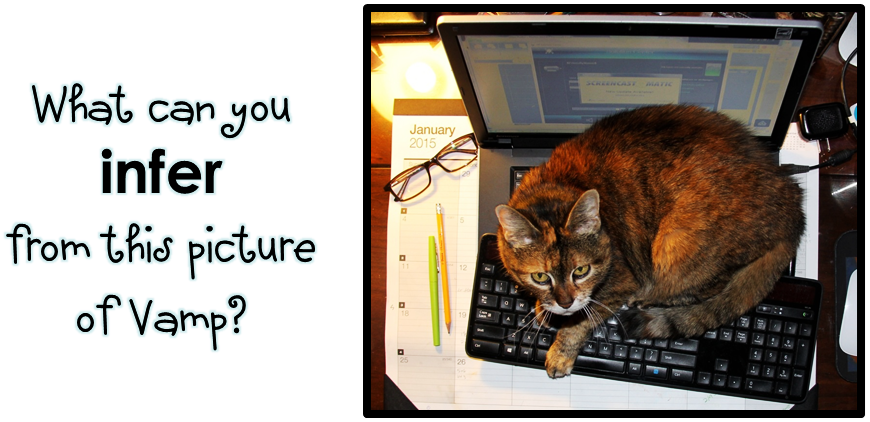
Take Vamp, for Inference

This is Vamp. She may look innocent here, but don't be fooled. 
Vamp is not a normal cat. She does things. Bratty things.


More on that later.


Today in class we learned about making inferences. This is something we do all the time when we are reading, enjoying movies, or even watching television commercials. To infer you need to find clues in the text and look for evidence in the pictures. You also use your background knowledge and pull from your past experiences to "read between the lines."


Here's a movie about inferences to help you understand the concept.


Got it?

Okay, let's give this a try.

What can you infer from this picture?


Mrs. Sol's response: I can see the boy has a blue tongue. From my past experience, I know that kids usually have blue tongues when they are eating something blue. I infer that the boy in the picture recently ate a blue popsicle, lollipop or candy (and he's happy about it). 


Now, use the same skills to infer details from a text passage...

Why is Jacob upset?

Jacob walked out of the shopping mall with his arms full of bags and the sun shining on him. As he approached his car, he started awkwardly feeling around his pockets with his arm full of bags. He did not find what he was looking for so he transferred the bags on one arm to the other arm, which already had bags. Jacob had a lot of bags on one arm. He still couldn't find what he was looking for. Now he dropped the bags and plunged both hands desperately into all of the pockets on his jeans. With a look of despair, Jacob ran to his car. He tried to open the door, but it was locked. Then he saw something on the passenger seat of the car. He stopped looking and pulled his phone out of his pocket.


Based on evidence given in the text, why do you think Jacob is upset? What happened? What can you infer from the information you have?


Finally, here's a commercial that you may have seen.

What does the boy think when the car starts?


This commercial tells a story, but without words. Can you infer enough information to answer the question? Inferencing skills you must have, young padawan. 


Here are some fun resources to help you practice your inferencing skills.


Now back to Vamp.


[click to enlarge]

What is happening in the photo of Vamp? 

What evidence supports your answer?

Type your answer in the chat window.

Keep up the great work!

Wednesday, October 7, 2015

RACE to SLASH!


Today's SLASH class was riveting! We continued working on ways to answer text-based questions completely. We have a fool-proof way to remember all of the parts of a convincing and thorough response. Just R.A.C.E. through it!

When we talk about R.A.C.E. Mrs. Sol's class is referring the "recipe" we use to remember the parts of a complete text-based response...


Read the question carefully. Does the question have many parts? Once you understand what is being asked, read through the text one more time and highlight the text evidence you find. If it's a magazine or book that you can't write in, you can use a sticky note to mark the spot.


When defending your answer, always cite information directly from the text! In our class, we take a quote from the text and copy it word for word. Since we are using someone else's writing, we always use quotation marks and cite where the quote came from.


The sentence starters above and in the R.A.C.E. printable will help you think of good ways to begin each sentence. For example, when quoting text, a good way to start might be:

In paragraph 2, the text states...

On page 32, Avi wrote...

In the article "Eskimo Life"...

Line 6 of the poem states... 

After citing the text and adding a direct quote, explain how the text excerpt proves your answer is correct. This is a good time to elaborate and add your own thoughts. Really convince the reader with the information and commentary you provide in your answer!

To explain further, here is an example of a complete text-based response. Click on the image to enlarge. 


What makes this a thorough and convincing answer?

We restated the question in our answer.
We answered all parts of the question.
We cited text, adding a quote from paragraph 3.
We explained our answer and added our thoughts.
So, in other words, we are awesome.

But what else is new?


Here is the TBR assignment for this week. Read the story called "The Wink" (above) and then answer the questions completely in your notebook. Use the information on this page and in your notebook to guide you. Edit your response as needed. Make sure words are spelled correctly, sentences are capitalized, and you remember all parts of the R.A.C.E. writing strategy. Then complete the online form before Friday (check your k-mail for the link).

Here's a peek at our notebook page for this week. The R.A.C.E. Flip Book!

You can print it at 75% if you want it smaller.


Thanks,

Thursday, September 3, 2015

SLASH!


What's SLASH, you ask? It's Language Arts with a little Science, Social Studies and History mixed in. Since Language Arts involves a lot of reading, discussion and writing, many of our lessons will feature historical events, famous Americans, Washington history, scientific wonders and other general awesomeness. We'll even dive into a novel or two!

SLASH is a multiple-subject smorgasbord, if you will.

Anywho, I enjoyed seeing my students in Class Connect this week! Wow, I have a bright group this year! In SLASH today, students did an impressive job of reading aloud, finding evidence in the text and answering questions like old pros... AND IT WAS THE FIRST DAY!
 
We learned a handy "recipe" for making sure our answer is complete and convincing when talking about something we've read.


Are you ready to R.A.C.E.? 


Here is an example...

[click on any picture on this post to enlarge it]


If you'd like to print R.A.C.E. strategy information 
and sample text above click here.

Every week we will practice our text-based responses in one way or another, so by the end of the year you'll all be experts! This skill will come in handy in all courses from now, through college... and beyond.

---------------------------------------------------------

This year we will save all of our Math and SLASH Class Connect notes and assignments in a spiral notebook. By June, you will have a cool (and super-fat) spiral notebook with all of the lesson information from the ENTIRE YEAR in one place! Please remember to bring your math and ELA notebooks to class each week. Notebook pages will be sent via k-mail, so you can add them to your notebook before class. You can also find many of them here.


Here is a peek at my 5th grade SLASH spiral


Today's R.A.C.E. printable should be added, right after the Table of Contents.


I used the Grip and Rip technique to add my pages...


---------------------------------------------------------

Homework Due 10/7/15:

Wednesday, January 21, 2015

January's Text-Based Responses

In class today we practiced answering text-based questions using the R.A.C.E. method. One of the articles our morning class read was on the Civil Rights Movement. Here is Hayden's response to the question According to the text, in what ways were black Americans' civil rights being violated? Notice how his answer is complete? He restated and answered the question, cited information directly from the text, and explained his reasoning. Way to go Hayden!


The afternoon class read this letter from a student to Mr. Peralta, a guest speaker who gave a presentation to his class.  


[click on the letter to enlarge it]

Here are thorough answers from two students (or should I say TBR Experts!)...


Awesome thinking Zion and Kaya!


Your assignment this week is to read the passage below. Then, think about the question. Write your response in your notebook, edit it, and k-mail it to me by Friday. 


QUESTION:
Do you live in a rural, urban, or suburban area?
Give evidence from the text to support your answer.


Remember to answer the question completely using R.A.C.E. 
Then, check spelling, capitalization and punctuation before k-mailing it to moi.


I look forward to your k-mails!

Wednesday, December 10, 2014

Text-Based Responses


Today's ELA class was riveting! We continued working on ways to answer text-based questions completely. We have a fool-proof way to remember all of the parts of a convincing and thorough response. Just R.A.C.E. through it!


When we talk about R.A.C.E. Mrs. Sol's class is referring the "recipe" we use to remember the parts of a complete text-based response...

(For the R.A.C.E. printable and rubric, click here.)

Read the question carefully. Does the question have many parts? Once you understand what is being asked, read through the text one more time and highlight the text evidence you find. If it's a magazine or book that you can't write in, you can use a sticky note to mark the spot.


When defending your answer, always cite information directly from the text! In our class, we take a quote from the text and copy it word for word. Since we are using someone else's writing, we always use quotation marks and cite where the quote came from.


The sentence starters above and in the R.A.C.E. printable will help you think of good ways to begin each sentence. For example, when quoting text, a good way to start might be:

In paragraph 2, the text states...

On page 32, Avi wrote...

In the article "Eskimo Life"...

Line 6 of the poem states... 

After citing the text and adding a direct quote, explain how the text excerpt proves your answer is correct. This is a good time to elaborate and add your own thoughts. Really convince the reader with the information and commentary you provide in your answer!

To explain further, here is an example of a complete text-based response. Click on the image to enlarge. 


What makes this a thorough and convincing answer?

We restated the question in our answer.
We answered all parts of the question.
We cited text, adding a quote from paragraph 3.
We explained our answer and added our thoughts.

So, in other words, we are awesome.

But what else is new?


Here is the TBR assignment for this week. Read the story called "The Wink" (above) and then answer the questions completely in your notebook. Use the information on this page and in your notebook to guide you. Edit your response as needed. Make sure words are spelled correctly, sentences are capitalized, and you remember all parts of the R.A.C.E. writing strategy. Then type it up and send it to me by Friday. 


Thanks,